
The selection of appropriate concrete production equipment is a critical determinant of project efficiency and economic viability. When evaluating solutions for small to medium-scale operations, two distinct technologies frequently emerge as contenders: the mobile batching plant with an output of approximately 25 cubic meters per hour and the self loading concrete mixer with a typical capacity of 6.5 cubic meters per hour. These systems represent fundamentally different operational methodologies and capital investment profiles. The mobile batching plant operates as a centralized production unit, while the self-loading mixer functions as an autonomous, integrated solution. A methodical comparison of their respective capabilities, operational parameters, and financial implications provides essential data for making an informed procurement decision aligned with specific project requirements and business objectives.
The core distinction between these two systems lies in their operational paradigm and resultant output potential, which directly dictates their suitability for different project scales.
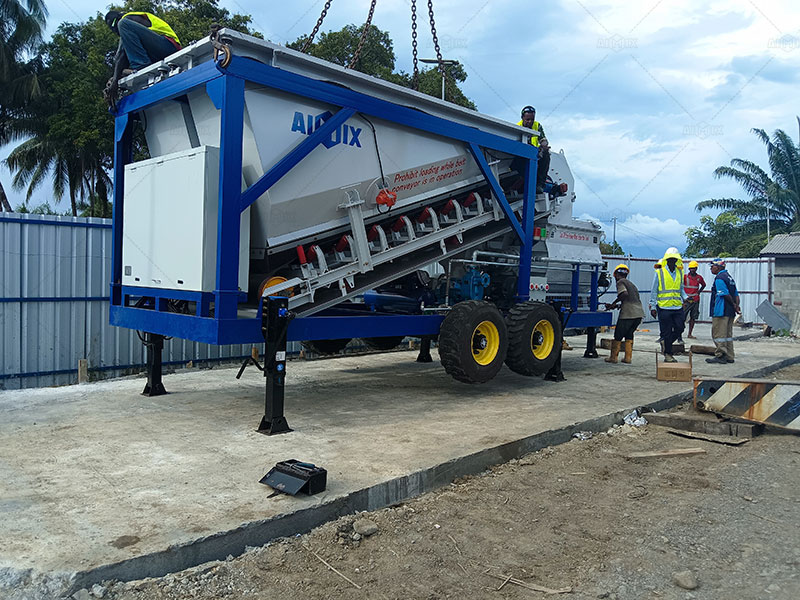
A 25m³/h mobile batching plant is designed for projects requiring a consistent, high-volume supply of concrete. This system operates on a batch-plant principle, with separate compartments for aggregates, a cement silo, and a water system. It requires a steady supply of raw materials, typically delivered by a wheel loader, and produces concrete in discrete, precisely measured batches. The 25m³/h rating indicates its maximum theoretical output under optimal conditions, making it suitable for supplying multiple trucks or feeding a large, continuous pour. Its operational modality is one of centralized production, where the plant remains stationary, and mixed concrete is transported to various points on site. This configuration is optimal for projects with a defined, stable production area and a clear logistical path for concrete distribution.
The 6.5m³/h self-loading mixer embodies a decentralized approach to concrete production. This machine is an all-in-one unit that combines a loader, a water tank, cement storage, and a mixer on a single mobile chassis. Its primary advantage is operational sovereignty; it can load its own raw materials from stockpiles, batch, mix, and discharge concrete without reliance on ancillary equipment. The 6.5m³/h output reflects its continuous mixing cycle, which is significantly lower than the mobile plant but offers unparalleled flexibility. It excels in settings with multiple, scattered pour locations, confined spaces, or projects where the logistics of supplying a central batch plant are complex or costly. Its production rhythm is steady but more suited to smaller, sequential tasks rather than a single, massive output requirement.
The physical and logistical footprint of each system varies considerably, influencing their deployment on different types of job sites.
The 25m³/h mobile concrete batching plant for sale , while mobile in the sense that it can be transported between sites, requires a substantial setup area. This includes space for the plant itself, aggregate stockpiles, and maneuvering room for support equipment like wheel loaders and transit mixers. It often requires a more robust, level foundation and access to a reliable water source and, ideally, three-phase electrical power. In contrast, the self-loading mixer has a dramatically smaller logistical tail. It can operate on relatively unimproved ground, requires no separate loading equipment, and can source water from a nearby tank. Its independence from extensive site preparation makes it exceptionally agile, capable of commencing production shortly after arrival on a site.
This is a domain of clear differentiation. Repositioning a mobile batching plant is a significant undertaking, often requiring a low-bed trailer and several hours of setup and teardown time. It is designed for medium-term deployment. The self-loading mixer, however, can relocate under its own power in a matter of minutes. It can be driven from one end of a project to the other, or even between nearby sites, with minimal loss of productive time. This operational agility is its defining characteristic, allowing it to service a dynamically changing work site with efficiency that a batch plant cannot match.
The financial justification for each system is intrinsically linked to the nature and scale of the contracting work undertaken.
The mobile batching plant represents a higher initial capital investment. This cost is offset by its lower cost-per-cubic-meter when operating at or near its full capacity, due to economies of scale. Its economic model is predicated on high utilization. The self-loading mixer has a lower entry price and different economic drivers. Its value is derived from the consolidation of multiple equipment functions—loading, batching, mixing, and transport—into a single asset, drastically reducing labor and ancillary machinery costs. It achieves profitability through operational consolidation and flexibility rather than pure volumetric output.
The 25m³/h portable concrete plant for sale is the appropriate choice for dedicated concrete production for housing estates, large commercial foundations, or precast yards where high, consistent demand is present. The 6.5m³/h self-loading mixer finds its optimal application in rural construction, road maintenance, smaller residential projects, and any situation characterized by multiple, discontinuous pours or challenging site access. The decision between them is not a question of which machine is superior, but which is the correct tool for the specific operational and financial context of the project portfolio.