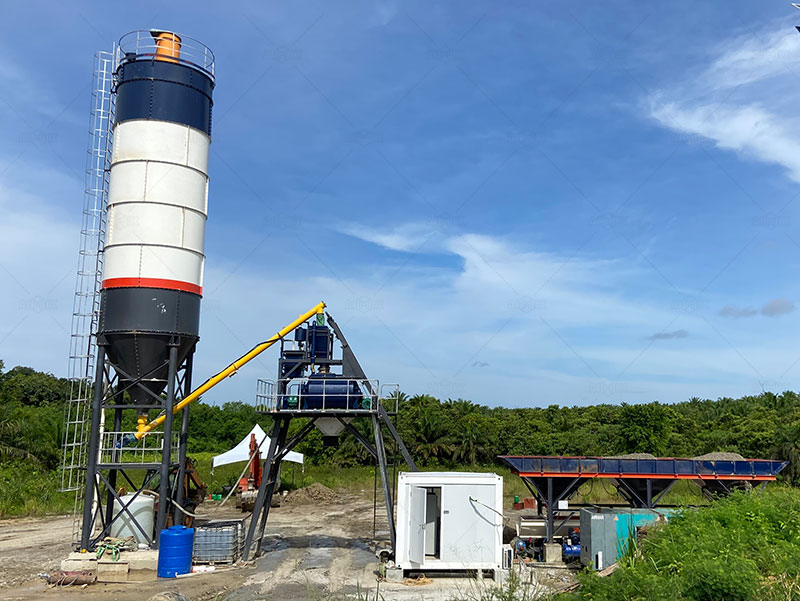
If you've followed construction in Saudi Arabia over the last few years, you've seen a landscape in hyperdrive. Projects seem to sprout from the desert overnight, from NEOM's futuristic lines to new residential communities and industrial hubs. But this incredible pace has a hidden, time-consuming enemy: the permanent foundation. The traditional process of building a large, stationary concrete plant involves weeks of excavation, steel reinforcement, and curing before it can even start producing. In a market where speed and flexibility are king, this old model is hitting a wall. That's why a new player is stealing the scene: the foundation-free, modular batch plant. And frankly, it's becoming a favorite for a host of very good, very smart reasons.
Let's talk about the single biggest advantage: velocity. In Saudi Arabia's construction sprint, project timelines are aggressive, and any delay cascades into massive costs. A foundation-free plant operates on a completely different clock. Think of it as a plug-and-play system for concrete production.
The name says it all. These modular plants are engineered to sit directly on a prepared, compacted ground pad or on heavy-duty steel skids. There's no need for deep concrete footings or complex underground works. This bypasses an enormous logistical and regulatory hurdle. You're not waiting for foundation concrete to cure; you're assembling pre-fabricated silos, mixers, and conveyors almost immediately upon delivery. What used to take 8-12 weeks for site preparation and foundation work can now be accomplished in a matter of days. For a contractor staring down a tight project milestone, this isn't just convenient—it's a game-changing strategic advantage.
This speed extends to the end of the project, too. When the last cubic meter is poured, a foundation-free concrete batch plant in Saudi Arabia doesn't leave a permanent scar on the landscape. It can be disassembled with a fraction of the effort and cost required to decommission a fixed plant. This rapid demobilization is perfect for the lifecycle of Saudi Arabia's giga-projects, which are often built in distinct phases or zones. The plant can be leapfrogged to the next phase or sold and relocated to an entirely new project, protecting your capital investment and maximizing its utility. It’s the epitome of asset agility.
Saudi Arabia's development isn't just fast; it's geographically vast and varied. Projects span from coastal megacities to remote desert sites. A fixed plant is, by definition, anchored. A foundation-free plant is a nomadic production hub.
For projects in remote areas where establishing permanent industrial infrastructure is impractical or cost-prohibitive, these plants are a revelation. They can be trucked in, set up on a basic pad, and become the sole source of high-quality concrete for an entire satellite community or industrial facility. Their modular nature also means they can be configured on-site to match specific output needs—scaling up or down by adding or removing mixer units or storage silos. This operational sovereignty in isolated locations is a powerful tool for national development, ensuring that quality construction isn't limited to areas with established supply chains.
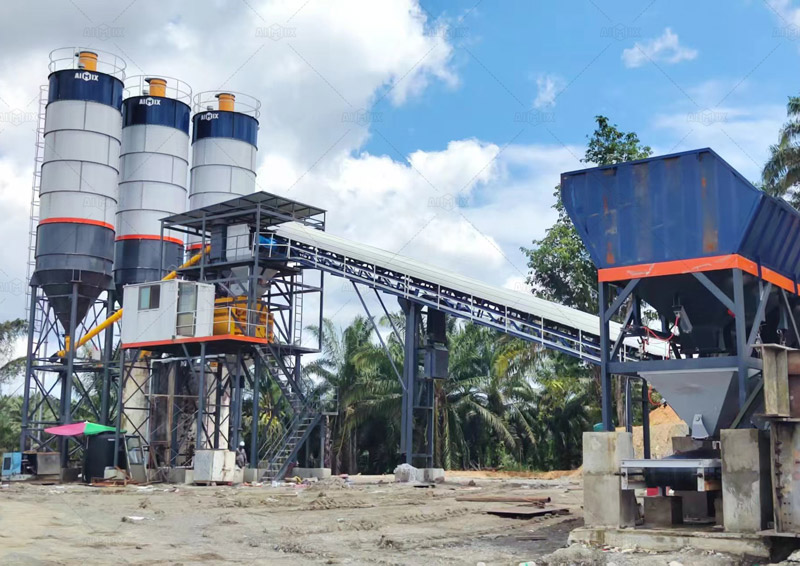
Even within cities, space is at a premium. A foundation-free modular ready mix concrete plant for sale can be configured in a "vertical" layout, stacking components to minimize its footprint. This makes it feasible to install a productive batch plant on a constrained urban lot, a temporary plot within a large project boundary, or even a brownfield site where digging deep foundations is risky or forbidden. This ability to fit into the urban puzzle allows for localized concrete production, slashing truck traffic and its associated congestion, pollution, and cost within dense project areas.
Beyond speed and flexibility, the financial and risk-mitigation calculus is compelling. In a sector known for its capital intensity, this model offers a smarter way to allocate resources.
The elimination of extensive civil works for a foundation represents a direct and substantial reduction in initial capital expenditure (Capex). This frees up capital for other critical project needs. Furthermore, because the plant can be operational so much quicker, it begins generating revenue almost immediately, improving project cash flow. The entire investment thesis shifts from a long-term, site-specific capital sink to a mobile, multi-project asset with a clearer path to return on investment.
Let's talk about a rarely discussed truth: technology evolves. Committing to a fixed plant with a 20-year horizon locks you into today's level of efficiency and automation. A modular, foundation-free plant offers a hedge against this obsolescence. After a major project, you can choose to upgrade specific modules—like the control system or mixer—for the next deployment, rather than being stuck with an entire outdated facility. It also mitigates the risk of being left with a stranded, unusable asset if a project is altered or a long-term material source shifts. In a market as dynamic as Saudi Arabia's, this future-proofing isn't a luxury; it's prudent business strategy. So, while the traditional plant is a monument, the foundation-free plant is a masterstroke of modern, adaptive engineering—perfectly tuned for a nation building its future at breakneck speed.